


We want to give you a snapshot of two classes in our STEM department: one introductory course and one of our more advanced offerings. Together, they illustrate the breadth of STEM opportunities at Gann Academy and the different pathways students can take to explore science, technology, engineering, and math.
Advanced Physics II
“Look for the physics, not the answer.”
It’s a reminder that Brendan Field, a former MIT lecturer, gives his students during a recent Advanced Physics II (Mechanics) class at Gann Academy. They’re working through a challenging problem involving friction, torque, and rotational motion, drawing on concepts from earlier lessons to understand how different forces affect an object’s movement.
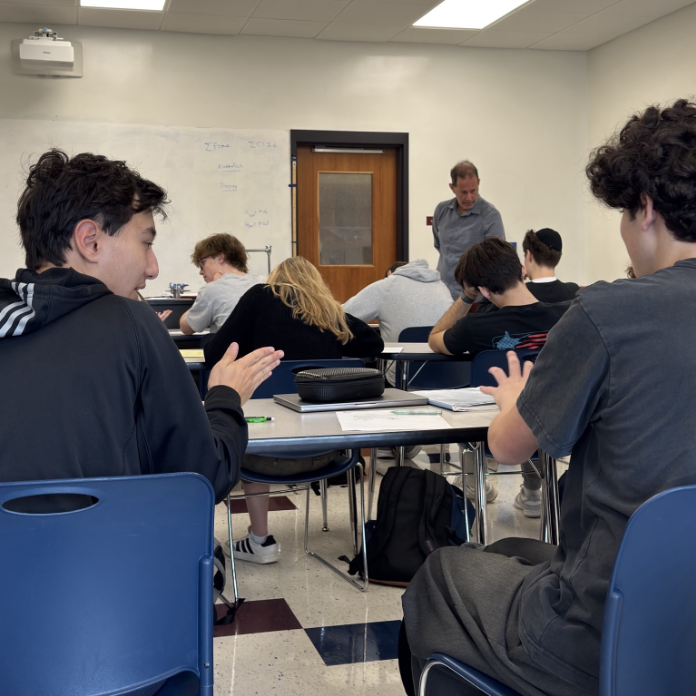
Around the classroom, students are deep in discussion. Working in small groups, they compare calculations, challenge assumptions, and sometimes arrive at entirely different conclusions. There’s plenty of back and forth, along with laughter and an eagerness to figure things out together.
When a student suggests using a familiar equation, Field asks, “When is that statement true?” The distinction is important. An equation may be mathematically correct, but applying it requires an understanding of the physical conditions involved.
Field moves between groups, listening and asking questions of his own. At another point in the lesson, a student asks whether energy could be used to solve the problem instead. Field acknowledges that it’s a valid approach, then explains why it would be less useful in this particular situation. There’s room for alternative ideas, even when they don’t lead to the most direct solution.
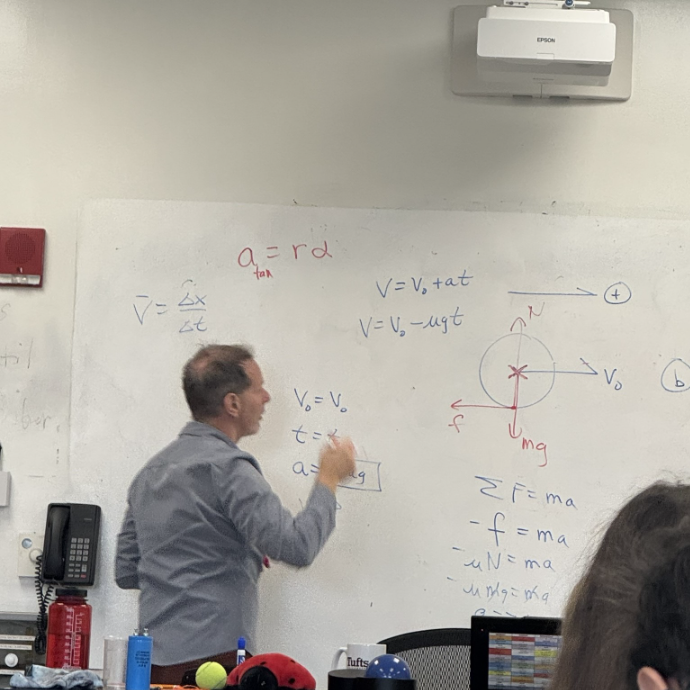
What stands out is the students’ enthusiasm. They’re comfortable questioning one another, willing to reconsider their thinking, and clearly enjoying the challenge.
Building Toward College-Level Science
The lesson offers a glimpse into Gann’s STEM curriculum, where foundational coursework leads to increasingly specialized, college-level classes. In Mechanics, students apply principles of force, energy, and rotational motion to complex problems. In Advanced Physics II (Electricity & Magnetism), the curriculum includes using calculus to study electromagnetic fields and building a simple electric motor.
The emphasis on understanding why something works extends across Gann’s STEM offerings. In mathematics, students are encouraged to explain the reasoning behind their solutions, while Computing, Design & Fabrication courses give them opportunities to apply technical skills through hands-on projects, from prototypes to robotics.
In Field’s classroom, students are expected to understand the reasoning behind their answers and recognize when something doesn’t add up.
Toward the end of the lesson, Field sets aside time for questions, reminding students that future problems will build on what they’re learning now. There are more questions, a few joking exchanges, and plenty of discussion before students move into their lab groups.
The work is demanding, but the atmosphere is lively and collaborative. Students are eager to contribute, comfortable challenging one another, and clearly enjoying the process of figuring things out together.
Principles of Coding
In Gann’s new Principles of Coding course, students can watch their code come to life. A pen moves across paper, following instructions they’ve written and turning digital information into a physical drawing.
The course focuses on giving students a deeper understanding of how coding works. Dr. Casey Moden has created a curriculum that helps students see the results of their coding in real time, making hands-on connections between math, programming, and art.
A recent project explores G code, a language that directs the movements of machines, including 3D printers. Dr. Moden introduced two pen plotters, devices that draw using code, so students could work with a simpler version of that process. Students write code that directs the pen to draw something specific, then watch their instructions take shape on paper. This helps demystify the “magic” of a 3D printer producing an object, giving students a clearer understanding of what’s happening under the hood.
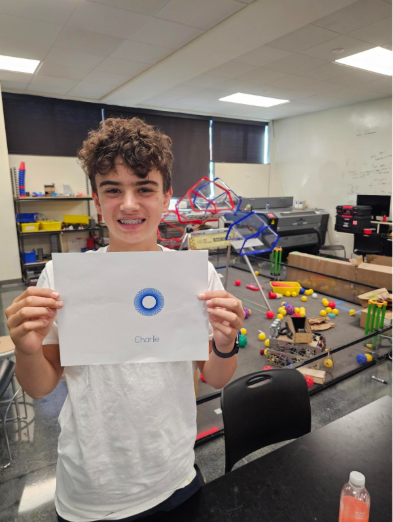
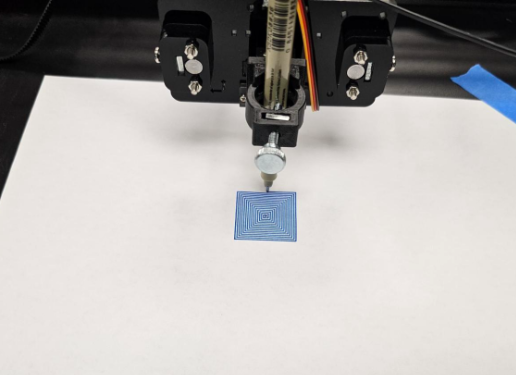
Now, students are exploring how digital images can be transformed into physical artwork. They begin with a color photograph and convert it to grayscale, creating a grid of pixels, each with a specific shade value. Students then write code that translates those values into varying densities of crosshatching: closely spaced lines create darker areas, while fewer lines create lighter ones.
For one student in the class, a welcome surprise has been discovering how many ways there are to approach a coding problem, and how revising code that doesn’t work is part of finding a solution.
After testing and refining the output on screen, students generate G code that directs the pen plotter to recreate the image, connecting concepts from programming, image processing, and computational art.
From an image on screen to a drawing on paper, students can follow each step and see how their decisions shape the result. What might once have looked like “magic” becomes something they can understand, experiment with, and create themselves.
Adapted from an original writeup by Alex Lahr, Gann’s Director of STEM and math faculty member.