


What does meaningful Israel education look like for today’s Jewish teens?
Dr. Yoni Michanie, Gann’s Director of Israel Education, points to two pillars in teaching: connection and knowledge, both necessary for students to engage with Israel in a way that is personal and informed.
For Yoni, this is more than a teaching philosophy; it reflects his own path through multiple places and cultures. Born in Buenos Aires, Argentina, he later lived in Miami before moving to Israel, where he served as an IDF paratrooper. He earned a master’s degree in Diplomacy and International Security from IDC Herzliya and recently completed his PhD at Northeastern University. His Zionism is grounded in a deep love of the people and land of Israel. This commitment shapes both the seriousness he brings to his work and his hope that students will come to see Israel as part of their own Jewish story.
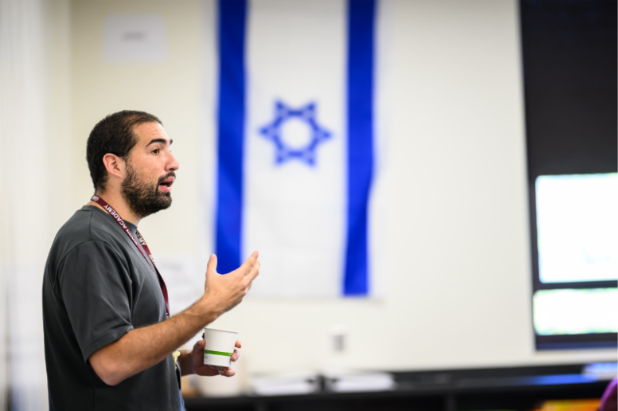
Yoni brings both deep knowledge and unmistakable enthusiasm to his classroom. His classes reflect Gann’s emphasis on active, engaging learning, pairing lectures and close reading with group exercises such as reenacting the landmark 1993 Oslo Accords or debating the terms of the 2011 Gilad Shalit prisoner exchange. Students must draw on what they have learned to make a case, respond to competing claims, and take history and one another seriously.
Gann graduate Elif Zanzuri ’25 described her time in Yoni’s class as “witty, driven, funny at just the necessary moments.” Students brought different levels of knowledge and different ways of participating. Despite those differences, she said, “with a passionate teacher and a collective curiosity, we engaged, challenged each other and grew.”
Gann’s investment in Israel education grew in part out of a curricular question: Should the history of the State of Israel be taught as Jewish studies or as history? That question shaped a program that draws on both, led by an educator devoted specifically to leading this work.
Jewish History 10 takes Gann 10th graders from the early medieval period through the establishment and early decades of the State of Israel. The curriculum predates October 7, but the attacks and their aftermath have underscored how crucial that historical grounding is for students trying to understand the present. In their senior year, every student chooses between two courses: Advanced Geopolitics of Modern Israel and Jew in the Modern World.
In Advanced Geopolitics of Modern Israel, students study Israel’s political and strategic landscape, including its borders, territorial disputes, the Israeli-Palestinian conflict, and evolving society. Jew in the Modern World covers much of the same geopolitical history while giving students more opportunity to reflect on their relationship to Israel and contemporary Jewish identity.
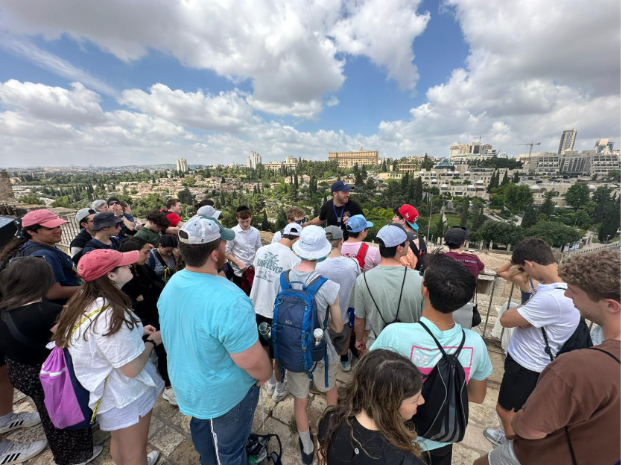
Travel programs offer students another way to access history. The senior myIsrael program serves as a capstone to Israel education at Gann, bringing together what students have learned with the experience of being in Israel themselves.
Ultimately, Yoni hopes students leave Gann feeling that they have a stake in Israel’s future. By bringing their personal connection to Israel into conversation with serious study, they begin to see themselves as participants in that future and in Jewish life.
Related blog posts: